2025-11-09 · RL-PL · 7 min read
Reinforcement Learning in the Ancient Scene
Reinforcement learning mirrors life: experience, rewards, and a Father who shapes policy through love and discipline.
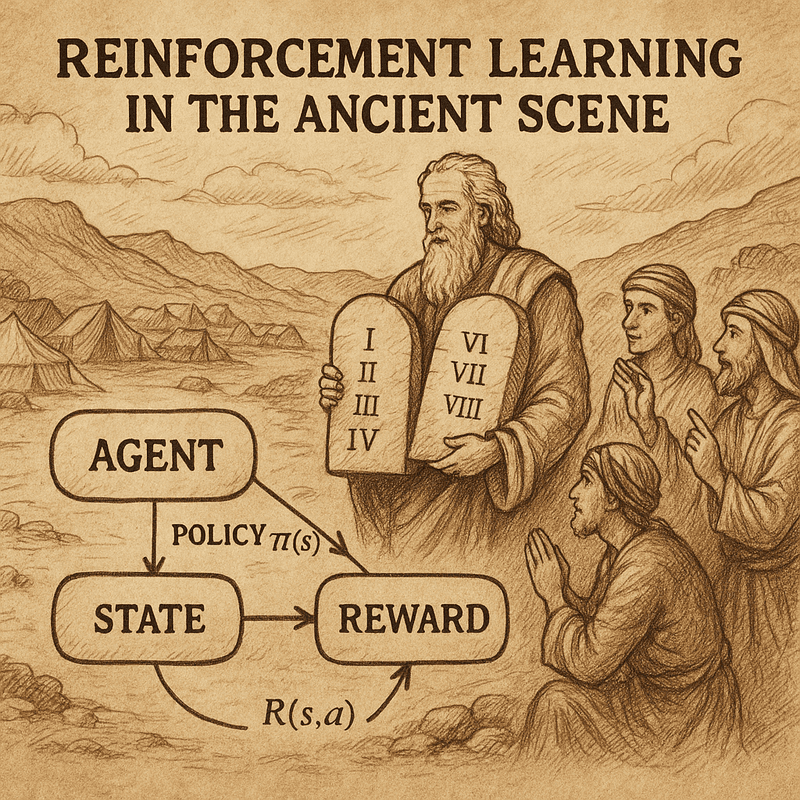
Reinforcement Learning is an AI method that learns through the repetition of a trial-and-error process to create a "good" policy that the AI agent can use as an optimal policy. Based on its experience, the AI agent will have the best policy for that case to maximize rewards (both short-term and long-term) and minimize punishments.
When I learned about RL, I found that it is similar to our life, in which we experience the world, learn by experiencing all things, and receive "rewards" (short-term or long-term) from human feedback, such as Reinforcement Learning from Human Feedback (RLHF). We also receive punishments/negative feedback from society through emotions or actions. Based on that, we develop our own policy, which we consider effective (or define "good" for ourselves), and we use it to determine the next action in a similar situation. For example, when I was a kid, I got a reward (love and praise) from my parents if I got a good mark at school, and got tons of questions and pressure to fix my score in class if I got a bad score. My Mom told me that if I didn't learn well and didn't finish school, I would become like her, to be a "lemper ayam" maker who needs to work hard to have a stable life. These simple habits and guidance from my mom help me create my "policy" to strive for education and study seriously.
I believe that our life experiences shape our (agent) policy π(s) based on our past experiences (states, actions, rewards). Because everyone has different experiences and reward signals (family, belief, culture, values), their learned reward functions R(s, a) differ — so the resulting policies differ too.
This situation is similar to what happened in the Bible when God shaped His people's corrupted mindset and slave mentality after 300 years in Egypt. God shaped them in the wilderness for forty years. I think that's more reasonable why God needs that long to change their mindset and make them rely on God. God molded their broken mentality by giving them short-term rewards, like:
- manna and quail (Exodus 16:4),
- water (Exodus 17:6),
- clothing and health (Deuteronomy 8:4),
- Guidance – Pillar of Cloud and Fire (Exodus 13:21–22),
- victory (Exodus 17:11–13)
- and a long-term reward—the promised land, Canaan (Deuteronomy 8:7–10).
God also gave negative rewards, such as:
- bitter water (Exodus 15:23–25),
- plague after craving meat (Numbers 11:33–34),
- and serpents for rebellion (Numbers 21:5–6).
We can see the pattern of rewards for obedience and punishment for rebellion. We may see God as a cruel God and discipline their people with a strong hand. But when we see it like a Father disciplining their naughty teenager, that makes more sense.
This forty-year repetition built a robust living policy for His people, so they not only received the Ten Commandments but also made it a foundation for learning. They built their culture and a behavioral policy through experience—learning to obey and fully trust Him in the wilderness.
As it is written in Deuteronomy 8:2–3, "Remember how the Lord your God led you all the way in the wilderness these forty years, to humble and test you in order to know what was in your heart, whether or not you would keep his commands... to teach you that man does not live on bread alone but on every word that comes from the mouth of the Lord."
When I learned Reinforcement Learning, I remember the beauty of how God uses the same pattern/algorithm to teach humans. Reflecting on the beauty of what He has done from my daily activities is a good way for me to remember and worship Him in my daily life. Perhaps someday I can invent a frontier algorithm inspired by His word from the bible.