2022 - Present · Industry
Engliven Learning & Operations Platform
A domain-heavy Laravel application—not CRUD plus auth, but hundreds of routes, nearly two hundred interactive server-driven UI units, dozens of service boundaries, and a relational model sized for real operations.
One platform for corporate English: scheduling, pedagogy, assessments, billing, and specialized programs (including Speak With Confidence), so clients, learners, teachers, and internal teams share a single source of truth.
Career chronology (About) This project was developed while I worked at Engliven (2019 — Present). Portfolio dates: 2022 - Present.
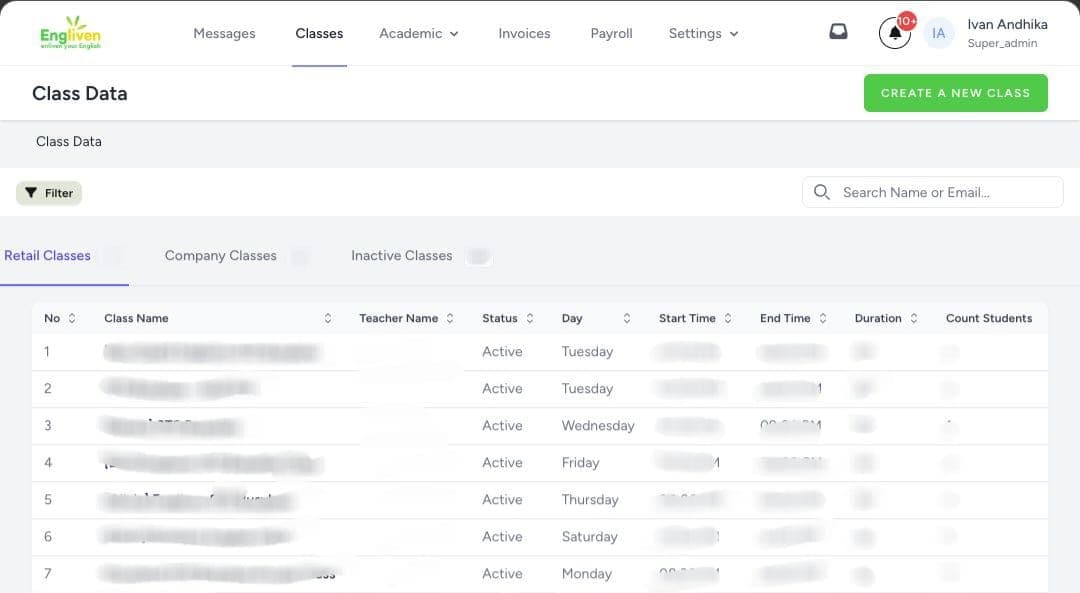
Company Overview
Engliven runs corporate English programs end to end. Clients, learners, teachers, and internal teams all need the same source of truth for scheduling, pedagogy, assessments, billing, and specialized programs—including Speak With Confidence, a dedicated speaking track.
The product goal is simple to state and hard to ship: one platform that stays coherent as rules, integrations, and teams grow.
Tech Stack
Data
- MySQL
Frontend
- Server-driven interactive UI
Backend
- Laravel
- PHP
Features & modules
- Identity and access: secure sign-in, team-style organization, and role-appropriate experiences.
- Clients and programs: corporate boundaries, packaged offerings, and operational views for internal staff.
- Academic operations: class design (types and modules), running cohorts, enrollments, lesson planning, evaluations, and formal assessments.
- People: student and teacher lifecycles, bulk operations where needed, and operational dashboards.
- Revenue: invoicing at learner and organization levels, payment integration, and alignment with registration flows.
- Growth funnel: lead and registration journeys wired into the same system as delivery.
- Flagship program (Speak With Confidence): curriculum-style topics, feedback loops, certification-style outputs, and tooling to support delivery at scale.
- Communication: in-product messaging, email-style notifications, and attendance-related comms.
- Supporting assets: documents, teaching resources, onboarding-style content, and reporting.
Operations & data scale
- ~350+ HTTP endpoints registered in total (rounded, indicative order of magnitude for external storytelling—not audited metrics).
- Classic JSON API surface is minimal: most behavior is browser-based and session-oriented, not a public REST catalog.
- On the order of ~50 domain entities, ~190 interactive server-driven UI modules, ~40+ HTTP controllers, and ~30 service or domain modules.
- Handle more than 10.000 rows of data per year as business volume grows.
Problem
Spreadsheets and disconnected tools do not scale when classes, invoices, and feedback loops multiply. Staff, teachers, students, and client-side users need different surfaces without duplicating data. Billing rules, academic workflows, and program-specific logic evolve over years; the architecture has to absorb that change without collapsing.
Approach
The application is a modular monolith: a single codebase with clear boundaries inside it. Core workflows use server-driven UI with rich interactivity—not a separate SPA. Controllers and UI components stay thin: validate, authorize, and delegate. Business rules and integrations live in dedicated domain service modules so policies stay testable and reusable. The relational schema evolves through a long history of incremental migrations, typical of a mature product rather than a greenfield demo.
System Architecture
- Presentation layer: server-driven UI with rich interactivity (hundreds of interactive UI units), not a separate SPA for core workflows.
- HTTP boundary: controllers and UI components stay thin; they validate, authorize, and delegate.
- Domain layer: business rules and integrations live in dedicated service modules (on the order of dozens of service classes) so policies stay testable and reusable.
- Data layer: a relational database with many dozens of tables and hundreds of columns in total, evolved through a long history of well over a hundred incremental schema migrations.
- Integrations (described generically): email delivery, a payment provider, error monitoring, document and PDF generation, spreadsheets and CSV, calendars, and optional AI-assisted features behind rate limits and validation—without coupling core workflows to a single vendor.
Outcome
One backbone replaces brittle manual processes as client and learner volume grows. Quality and consistency of delivery benefit from structured lesson, evaluation, and program data instead of ad hoc files. Speak With Confidence sits inside the same platform as CRM-adjacent and finance-adjacent flows, which reduces duplicate data and operational risk.
Key Contributions
- Modular monolith architecture in Laravel that keeps academic, commercial, and flagship-program logic on one transactional core with explicit domain boundaries instead of logic scattered across views.
- Large server-driven product surface sustained by delegating rules to dozens of service modules; core workflows remain session-oriented rather than dependent on a minimal public JSON API.
- Long-lived relational model and migration discipline (many dozens of tables, hundreds of columns in aggregate, well over a hundred migrations) so billing, pedagogy, and program-specific rules can evolve without losing structural coherence.
- Generic integration stance—email, payments, monitoring, documents and PDFs, spreadsheets and CSV, calendars, optional AI-assisted features behind rate limits and validation—so core workflows are not locked to a single vendor.